
Climate impact car recycling - Celebrating 25 years of IARC with new insights into CO₂ savings
At this year’s International Automotive Recycling Congress (IARC), Febelauto is pleased to share the results of a new CO₂ study that highlights the climate benefits of responsible end-of-life vehicle (ELV) recycling in Belgium.

The recycling of an end-of-life vehicle in Belgium saves on average 3,400 kg of CO₂ equivalent, which corresponds to the annual absorption of 155 mature trees.
A new study conducted by Febelauto shows the extent of the climate benefit when end-of-life vehicles are collected and processed according to the official Belgian procedure. Until now, there were no concrete figures to prove this climate benefit, but thanks to this study, we not only know how much CO₂ emissions are avoided through sustainable vehicle recycling, but it also provides all stakeholders – from policy makers to businesses and consumers – with the tools they need to make this impact visible, report on it and use it in the future. An overview:
What does the study show?
The study was conducted by Eco Repair Score in collaboration with VITO (Flemish Institute for Technological Research). They calculated the greenhouse gas impact of end-of-life vehicle treatment in Belgium and compared the unavoidable CO₂ emissions with the CO₂ savings achieved.
Yes, ‘savings’, because an end-of-life vehicle is not waste, but a valuable source of reusable parts and secondary raw materials. The sustainable treatment of a vehicle at an ATF (Authorised Treatment facility) avoids the production of new vehicle parts, the extraction of primary raw materials and the production of energy, thereby significantly reducing CO₂ emissions.

The study shows that processing an average end-of-life vehicle generates 666.1 kg of CO₂ equivalent, but that 4,063.9 kg of CO₂ equivalent can be avoided through reuse, recycling and energy recovery. This results in a potential net climate benefit of 84%, or 3,397.8 kg of CO₂ eq. per vehicle.
(*) The CO₂ emissions obtained are expressed in CO2 eq. CO₂ equivalent is a measure that indicates the extent to which a given amount of greenhouse gas contributes to global warming, with 1 kilogram of CO₂ equivalent being equivalent to the greenhouse effect of 1 kilogram of CO₂. In this way, the effects of different gases can be compared effectively.
Other important conclusions
Each end-of-life vehicle recycled in a sustainable manner yields an average of 1,100 kg of extracted raw materials, thanks to the reuse of vehicle parts and the use of secondary raw materials after recycling.
The reuse of dismantled parts (which represent an average of 23% of the weight of an end-of-life vehicle) accounts for 48% of avoided emissions, demonstrating the major climate benefit of extending product life through the use of used car parts for repairs.

Each end-of-life vehicle recycled in a sustainable manner yields an average of 1,100 kg of extracted raw materials, thanks to the reuse of vehicle parts and the use of secondary raw materials after recycling.
The reuse of dismantled parts (which represent an average of 23% of the weight of an end-of-life vehicle) accounts for 48% of avoided emissions, demonstrating the major climate benefit of extending product life through the use of used car parts for repairs.
Most of the emissions associated with processing are generated during the recycling of ferrous metals, energy recovery through incineration, and the mixing of ASR polymers (automotive shredder residue, incinerated plastic waste).
- Although recycling steel generates approximately 340 kg of CO₂-eq emissions due to the energy and raw materials required for its processing, it remains the greatest climate benefit specific to the material. This is because recycling steel avoids more than 1,300 kg of CO₂-eq that would otherwise be generated by primary steel production.
- Aluminium, which accounts for only 6% of vehicle weight, accounts for 12% of total emissions avoided, due to the energy intensity of primary production.
- Recycled polymers and energy recovered from incineration also contribute, to a lesser but significant extent, to the total CO2 emissions benefit.
How was the study conducted?
The study is based on a life cycle assessment (LCA). It evaluates the environmental impact of a product, process or service throughout its life cycle. The term ‘life cycle’ refers to the main stages of the product, service or process, including raw material extraction, production, transport, use and maintenance, as well as waste or recycling in a possible subsequent life cycle.

The study was conducted using the Environmental Footprint 3.1 methodology, recognised by the European Commission. Modelling was carried out using SimaPro software.
The primary objective of the study was to quantify CO₂ savings. To do this, we took into account:
- Vehicle collection and transport
- Treatment of hazardous substances (depollution)
- Vehicle dismantling and reuse of parts
- Shredding and sorting of material fractions for raw material recovery
- Heat and energy recovery through incineration of residual flows.
To do this, we examined:
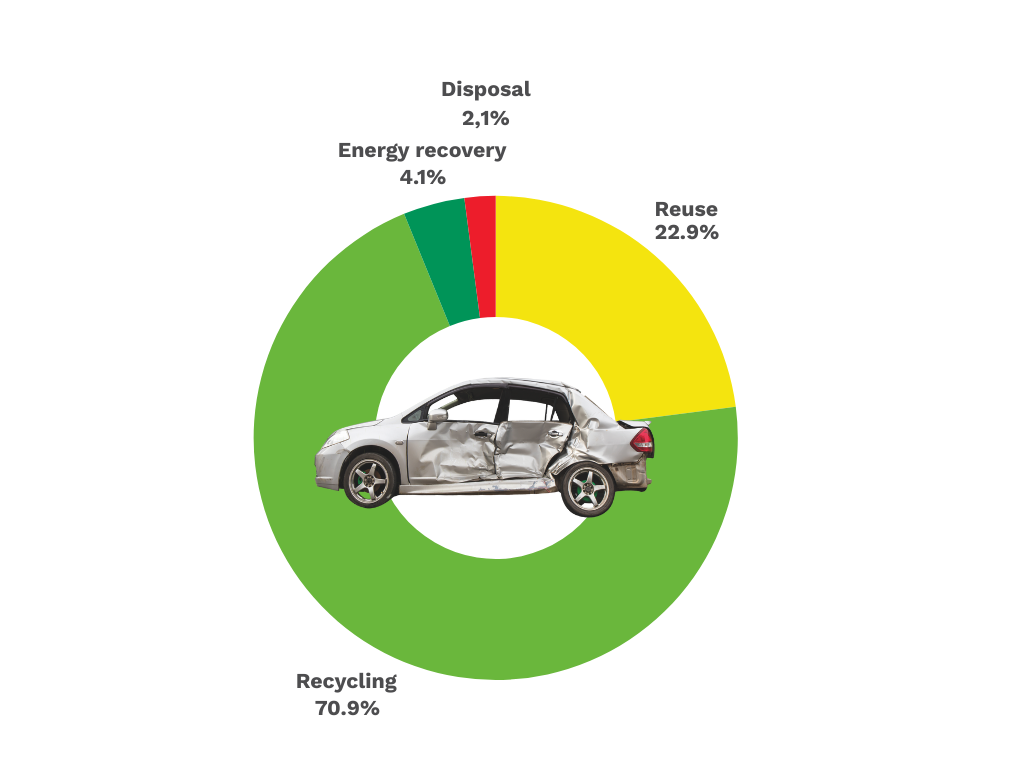
- Febelauto's 2023 recycling results: In Belgium, 98% of a vehicle's weight is recovered at the end of its life cycle. 23% of the weight is reused as second-hand car parts, 71% is recycled to recover valuable raw materials and 4% is used for energy recovery.
- A study by RDC on the average composition of the seven best-selling vehicles in 2014. The data is relevant given that the average age of an end-of-life vehicle brought to an approved centre is now 18.5 years.
- Data from the Swiss Ecoinvent database to quantify the environmental impact of recycling and energy recovery.
- Recovery rates and material quality factors were taken from the circular footprint formula of the PEF and recent LCA literature on life cycle analysis.
Why is this study important?
This study confirms that the treatment of end-of-life vehicles in Belgium offers significant benefits in terms of climate and resource conservation, thereby strengthening its role in the national circular economy and supporting Belgium's broader transition to a low-carbon economy.
But this study does not only provide interesting information for Febelauto. It can benefit anyone with responsibility in the field of vehicles, the circular economy and CO₂ reduction. It provides valuable information for the development of policy strategies, various reporting obligations (VSME, CSRD, ESG, etc.), for marketing and communication purposes, and even for eco-design.
‘You can't manage what you can't measure,’ says Catherine Lenaerts, director of Febelauto. ‘The strength of this study is that it does not remain theoretical. It quantifies the real climate benefits of car recycling as practised in Belgium today. We provide reliable and transparent figures that enable our stakeholders to effectively monitor, report and communicate their environmental impact.’
What does this study mean to you?
As a consumer

Have your car recycled by an ATF and avoid up to 3,400 kg of CO₂ emissions. That's as much as 155 trees absorb each year*. And it brings you much more than just satisfaction: it's a measurable contribution to the climate.
Also, consider used spare parts when having your car repaired. Second-hand parts are just as good, often cheaper and, above all, much more environmentally friendly!
By recycling your car sustainably and giving used spare parts a chance, you are really making a difference.
As a business, leasing company or insurance company

Are you responsible for managing vehicles or a fleet? Sustainable mobility does not end at the end of a vehicle's life. The cycle is only complete after the vehicle has been sustainably recycled and any usable parts and valuable raw materials have been recovered. The figures from this kind of study* are perfectly usable for developing a sustainable and circular policy and can also be used in VSME and CSRD reports. Businesses can add the ATF’s certificates of destruction to their audit, tender or report as a proof.
Also consider used spare parts when repairing your cars and include all these results in your internal and external communications.
As a local authority
Properly collected and recycled vehicles are a powerful lever for local climate policy. By properly processing end-of-life service vehicles or abandoned cars through ATF’s, they make a tangible contribution to reducing greenhouse gases. These climate gains* can be included in municipal climate reports, action plans or sustainable fleet management audits. Attach the ATF’s certificates of destruction to your reports, audits or grant applications.
Also consider used spare parts when repairing your cars and include all these results in your communications to residents.
As a policy maker

For policy makers, this kind of study* highlights the importance of good traceability of vehicles at the end of their life in the fight against global warming and the judicious management of natural resources. Only when vehicles are collected and processed through ATF’s, we can objectively measure, monitor and report. Illegal export or unregistered processing not only harms the circular economy but also leads to missed opportunities in terms of raw material recovery and greenhouse gas reduction.
As an approved centre, collection point (garage) or recycling partner

This kind of study* confirms the value of your work: you are making real climate gains every day. Use it to communicate your environmental performance to your customers, partners, authorities and local residents. You can also use the result in grant and loan applications.
* Please note that this is a Belgian study and that the figure of 3,400 kg eq cannot be adopted by other countries. The parameters underlying the study must be adapted to the life cycle analysis in each individual country. Our main aim here is to demonstrate the value of such a study.
As a car manufacturer or importer

For car manufacturers, this kind of study* provides a solid basis for a sustainable policy. You can calculate how many cars of your brand have been processed by all the ATF’s in a certain country and thus estimate the annual ‘avoided emissions’ of CO₂ eq. This figure can also be used in your VSME, CSRD and ESG reports, because sustainable mobility does not end at the end of a vehicle's life – let's close the loop together.
Furthermore, recent studies show that consumers are becoming increasingly critical of vague sustainability claims and are well aware of attempts of greenwashing. This kind of study provides clear, scientifically based figures on the climate benefits of sustainable vehicle recycling. It informs consumers that recycling their vehicle at an approved centre is not only the right choice, but also makes a real and measurable contribution to reducing CO₂ emissions. Transparency creates trust – and these figures make the difference visible.
Since the study methodology is based on the European Commission's recognised Environmental Footprint 3.1, it also offers insights into the future of your products. For example, the results can serve as a basis for eco-design strategies. Among other things, they show that the reuse of spare parts accounts for almost half of the emissions avoided and that the recycling of steel and aluminium is particularly climate friendly. Manufacturers can use this information to determine which design choices (such as dismantlability and material selection) can improve the circularity of vehicles and reduce their carbon impact.
Important points to consider

Although this study provides a robust and transparent quantification of the environmental benefits of end-of-life vehicle treatment, certain limitations must be acknowledged:
- The figures are based on an average Belgian passenger car weighing 1,261 kg with a combustion engine, i.e. excluding light commercial vehicles and trucks. Furthermore, the number of end-of-life electric vehicles processed in approved centres in Belgium is still too low to be taken into account in the study.
- The results were calculated across the entire value chain – from the collection of end-of-life vehicles to the sorting of fractions. The emissions avoided should therefore be considered as the result of a collective effort across the value chain and should not be attributed to individual actors.
- The emissions avoided cannot be added to other sustainable activities. However, the emissions avoided can be multiplied by the number of end-of-life vehicles that are properly treated (certificates of destruction).
- In the case of reuse, the study assumes a 1:1 substitution between reused parts and new parts, without taking into account any degradation, reduced performance or shorter service life of reused parts compared to new replacement parts. This modelling choice may lead to an overestimation of avoided emissions in situations where reused parts have a shorter service life.
- To determine the amount of primary raw materials avoided (extraction, transport, production), the quantities of each equivalent primary material were added up based on recovery rates and quality factors. These are based on literature and general assumptions and may not fully reflect the variability of recycling practices, local conditions, or energy mixes in practice.
- The study assumed an average transport distance per vehicle processed in Belgium of 40 km from the collection point to the approved centre and 40 km from the approved centre to the shredding plant.
Every recycled car counts!
This study highlights one thing: what happens at the end of a car's life really makes a difference. Whether you are a consumer, policy maker or entrepreneur, the correct recycling of end-of-life vehicles via ATF’s offers concrete climate benefits, avoids the extraction of new raw materials and contributes to the circular economy in Belgium.